
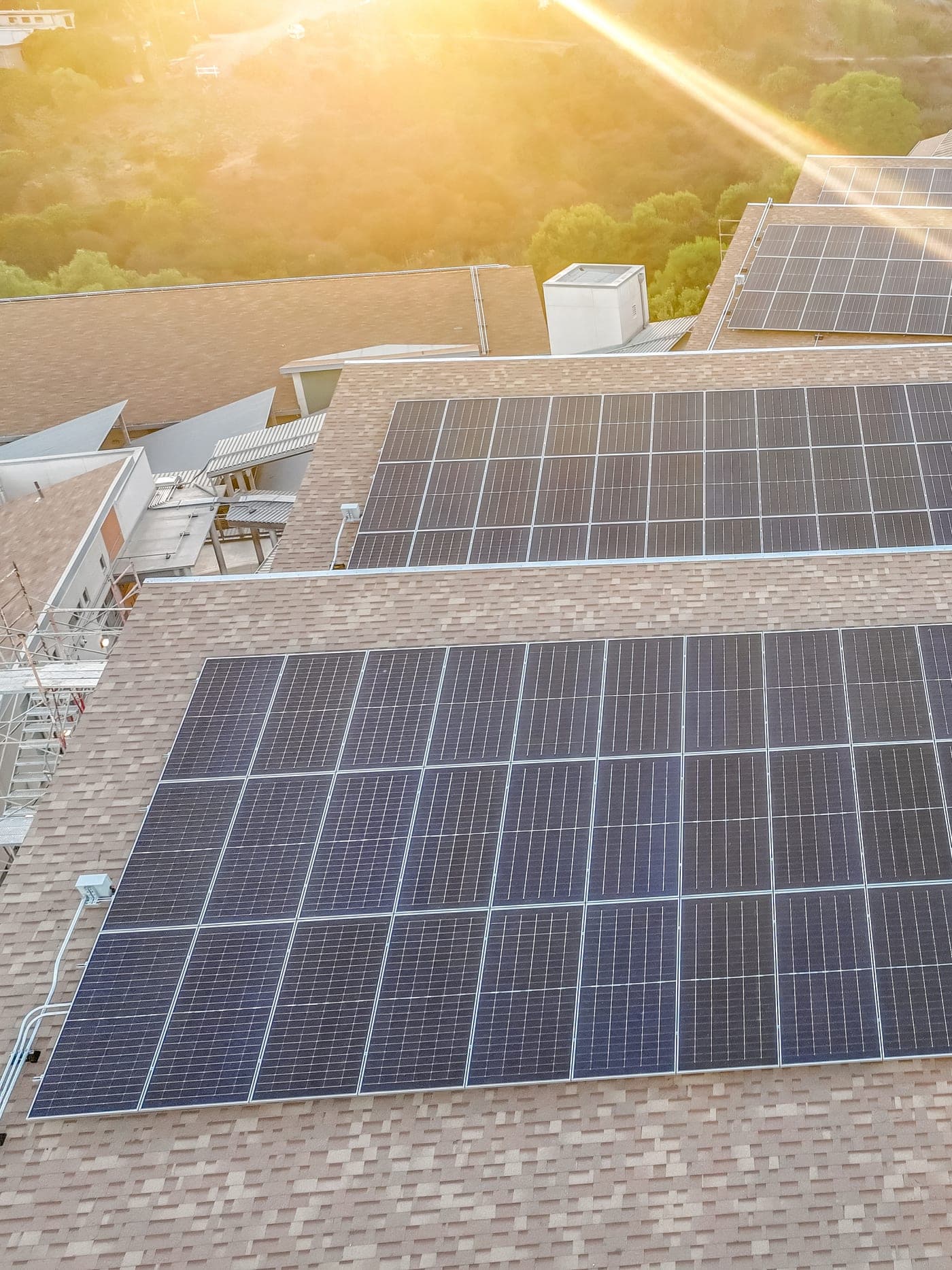
Solar installation underway on a commercial construction project
Industries We Serve

Solar as Standard in Commercial Construction

For builders and developers in San Diego County

Solar added to a finished building is a retrofit. Solar specified into the drawings is a building system, and it costs less, looks better and performs better for it.

This page is for builders and developers: where solar actually fits in a construction programme, what California now requires, and how to coordinate it without it becoming the thing that holds up handover.

01

It Is Increasingly Not Optional

California's Title 24 energy standards require photovoltaic provision on many new buildings. The applicable requirement depends on building type, size and the code cycle in force in your jurisdiction, and the standards are revised on a cycle — so this is a question to settle at the start of a project rather than assume from the last one.

The practical consequence is that on a growing share of commercial work, the question is no longer whether to include solar but whether it was designed in or bolted on afterwards.

02

Designed In Costs Less Than Added Later

The saving is not in the panels. It is in everything around them.

  • Conduit routed during first fix rather than surface-mounted afterwards.
  • Electrical service and switchgear sized once, for the finished building.
  • Structural provision made in the frame rather than reinforced later.
  • Roof penetrations and attachment coordinated with the roofing package instead of cutting into a completed membrane.
  • Mechanical plant located so it does not shade the best roof plane.
  • One mobilisation rather than two.
The expensive version

Solar added after handover means opening up finished work, a second mobilisation, and often accepting a compromised array layout because the good roof plane now has plant on it.

03

What Solar Does for the Completed Asset

You will find confident figures published about how much solar raises rents and property values. We are not going to repeat them, because they vary enormously by market, asset class and lease structure, and quoting an average as though it described your project would not be honest.

What can be stated plainly: the building's energy costs are lower and more predictable, that is measurable from actual bills once it is occupied, and for tenants with their own environmental reporting obligations a generating building is a credential their competitors' buildings do not have.

Whether that translates into rent or absorption in your specific market is a question for your agent, not your solar contractor.

04

Sequencing Without Moving the Programme

  • Feasibility and indicative sizing at schematic — cheap, and it protects the roof plane.
  • Structural and electrical provision confirmed during design development.
  • Attachment details and conduit routing into the construction documents.
  • Array installation sequenced immediately behind the roofing package.
  • Utility interconnection application submitted early — this is the item most likely to sit on the critical path, and it is largely outside anyone's control once lodged.

Interconnection is the one to start early. Design and installation can be compressed if they have to be; a utility queue cannot.

05

The Tax Position for the Owner

Worth understanding even though it is your client's concern rather than yours, because it affects whether the solar package survives value engineering.

Section 48E provides a 30% federal credit on qualifying commercial solar. The base rate is 6%, rising to 30% with prevailing-wage and apprenticeship compliance — but facilities below 1 MW are exempt from those requirements and reach the full rate automatically. Most commercial buildings fall below 1 MW.

If the end user is a school, church, nonprofit or public agency, direct pay means they receive that value as a payment even with no tax liability. On institutional work that changes the conversation entirely. Federal tax rules changed in 2025 and 2026 and this page reflects the position as at August 2026. Nothing here is tax advice — we design and install the system and work alongside your accountant on how the credit applies to you.

06

What We Provide to a Construction Team

  • Production modelling and shading analysis at feasibility.
  • Coordination drawings and attachment details for the construction set.
  • Electrical single-line coordination with your electrical contractor.
  • Interconnection application and management with SDG&E.
  • Installation sequenced against your programme, not ours.
  • Commissioning, monitoring and handover documentation for the building owner.

We also install battery storage and EV charging, which on commercial projects are increasingly specified together — and are considerably cheaper to provision at construction than to add later.

Questions from Builders and Developers

It applies to many new commercial buildings in California, but it depends on building type, size and the code cycle in force in your jurisdiction. Settle it at the start of the project rather than carrying an assumption from the last one.

Installation itself is short and sequences behind the roofing package. The item that can affect the programme is utility interconnection, which is why we submit that application early rather than at completion.

It varies by building, but the saving is in conduit routing, service sizing, structural provision and a single mobilisation — not in the hardware. The gap widens on larger and more complex buildings.

The system owner. On a build-to-suit or owner-occupied project that is your client, and if they are a school, church or nonprofit, direct pay means the credit is worth real money to them even with no tax liability.

Yes, and that is most of the job on new construction. We sequence to your programme and coordinate with the roofing and electrical trades rather than expecting the site to work around us.

Frequently the best option on projects with substantial parking — they generate, shade vehicles, and provide the structure for EV charging without a separate build. Our largest installation is a 487.7 kW carport.

Yes. Provisioning charging infrastructure during construction is dramatically cheaper than retrofitting it, and on many commercial projects it is worth installing conduit even where the chargers come later.

Talk to us before the roof plan is fixed

We work to construction schedules on commercial projects across San Diego County — coordination drawings, sequencing against the roofing package, and a realistic interconnection timeline. Call 858-281-5110.