
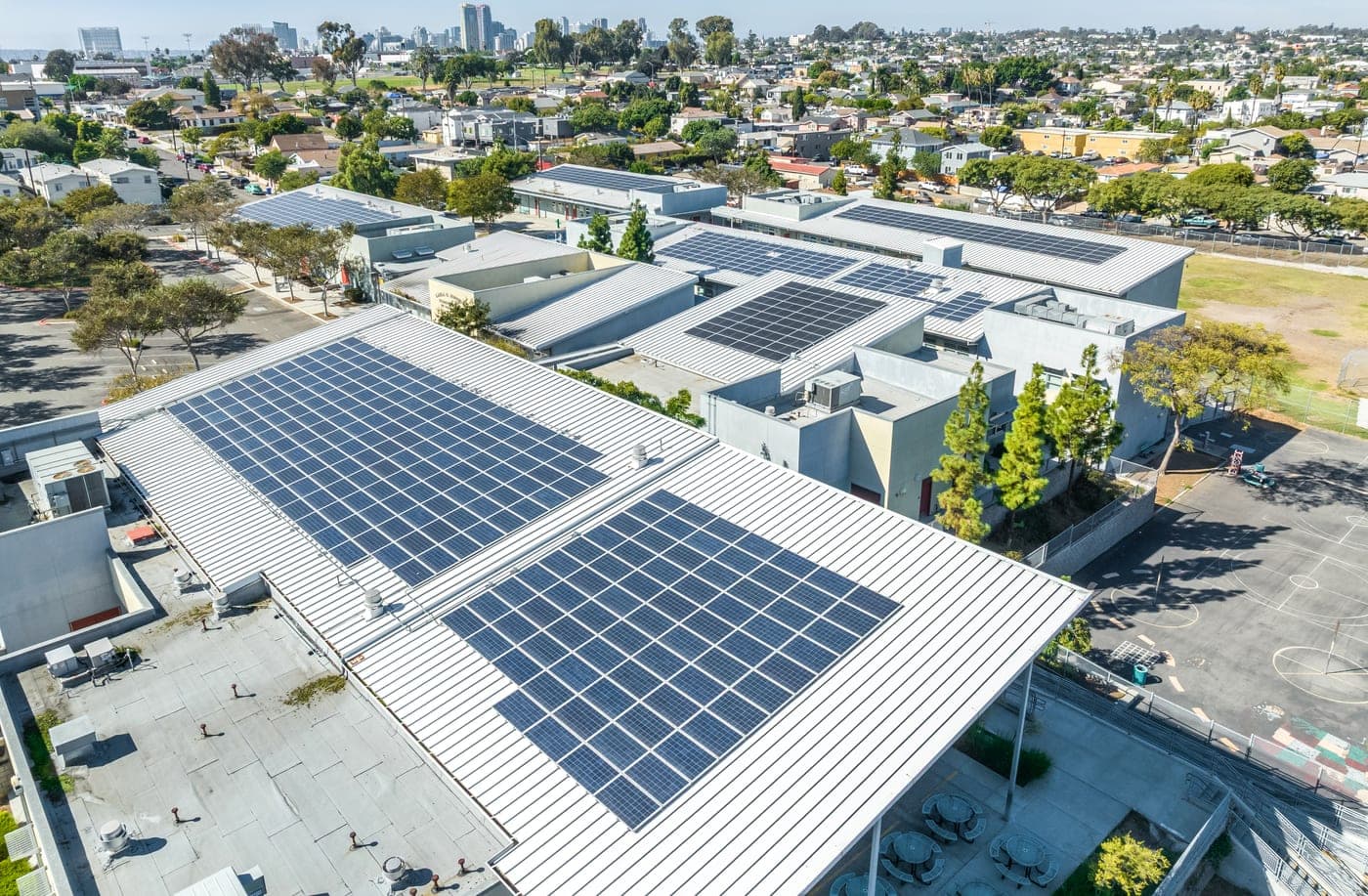
Commercial rooftop solar installation in San Diego County
Financial Incentives & Solar Financing

What Commercial Solar Costs in San Diego

2026 pricing, incentives and the costs quotes leave out

The first question every business owner asks is what it costs, and the honest answer is that commercial solar pricing is not one number. System size, roof type, interconnection complexity and whether you add storage all move it substantially.

What follows is how the price is actually built, which incentives survived the 2025 changes, and the costs that do not always appear in a proposal until later.

01

What Actually Drives the Price

Commercial solar pricing is not one-size-fits-all. Six variables move it more than anything else.

  • System size — larger systems cost less per watt. A 500 kW rooftop lands at a lower per-watt figure than a 50 kW system.
  • Equipment tier — premium panels cost more upfront and hold output better under San Diego's UV load.
  • Roof condition and type — flat TPO needs ballasted racking, sloped metal uses clamps, and structural upgrades add cost.
  • Interconnection complexity — SDG&E's queue and any transformer or service work is often the largest single variable on a big project.
  • Storage — adding a battery raises the capital cost and materially changes the NEM 3.0 economics, usually in your favour.
  • Financing structure — cash, a commercial loan, C-PACE or a PPA each produce a completely different net cost picture.
02

The Federal Credit in 2026

This section is worth reading carefully, because a lot of material published before mid-2025 is now wrong.

Commercial solar falls under Section 48E, the Clean Electricity Investment Credit. The base rate is 6%, rising to 30% where a project meets federal prevailing-wage and registered-apprenticeship requirements.

The exemption is what matters for most San Diego buildings: a facility with maximum net output below 1 MW AC is exempt from those labour requirements and receives the full 30% automatically. Virtually every commercial rooftop and carport in the county sits below that threshold.

Two adders can push the commercial credit higher: 10% for meeting domestic-content thresholds, and 10% for projects in designated energy communities. Federal tax rules changed in 2025 and 2026 and this page reflects the position as at August 2026. Nothing here is tax advice — we design and install the system and work alongside your accountant on how the credit applies to you.

And for homeowners

The residential credit under Section 25D was terminated for expenditures made after 31 December 2025. If you are pricing a home system, that 30% no longer applies. The commercial and residential positions genuinely diverged.

03

California Incentives That Still Apply

SGIP

The Self-Generation Incentive Program provides rebates for battery storage through the CPUC. Categories, budgets and rates move, so we confirm what is genuinely available to you at quoting rather than printing a figure that may already have shifted.

Property tax exclusion

California excludes the added value of a qualifying solar system from property tax assessment, so improving the building does not increase the assessment on that basis.

Sales and use tax

Partial exclusions apply to qualifying equipment. Your accountant will confirm the treatment for your purchase structure.

USDA REAP

Qualifying rural businesses and agricultural operations can access grant funding through the Rural Energy for America Program. Relevant to inland San Diego County agricultural operations more than to coastal commercial.

04

NEM 3.0 and What It Did to Payback

Any San Diego business interconnecting after April 2023 falls under Net Energy Metering 3.0, which cut compensation for exported energy substantially compared with NEM 2.0.

That changes system design more than it changes whether solar is worth doing.

  • Self-consumption matters more than capacity. Systems should be sized against what the building actually uses on site, not against roof area.
  • Storage moves from optional to central. A battery lets you shift generation into the expensive evening hours instead of exporting it cheaply at midday.
  • Payback shifts. Without storage, NEM 3.0 lengthens payback against the old tariff. With correctly sized storage it can land comparably.

We model every NEM 3.0 project storage-first for that reason, and we show you the comparison rather than asking you to take it on trust.

05

Costs That Do Not Always Appear in a Quote

Not every installer puts these on the first page. Ask about all five before you compare proposals.

  • Interconnection — SDG&E application fees, and potentially transformer or service upgrades. On larger systems this can be the biggest single line after the hardware.
  • Permitting — city and county fees vary by jurisdiction.
  • Structural engineering — load analysis, and reinforcement where an older roof needs it.
  • Electrical upgrades — panel capacity, conduit runs and metering changes.
  • Monitoring — should be included by any reputable installer. Confirm it in writing.
The one that costs most to get wrong

Roof condition. Installing over a roof with a few years left means paying to remove and refit the array later. We assess it before designing anything and will tell you to re-roof first if that is the cheaper path.

06

How We Build a Proposal

  • Production modelling using real satellite irradiance data for your specific address, not a regional average.
  • Utility bill analysis identifying your rate schedule and demand-charge exposure.
  • Financial modelling including the federal credit, storage rebates, depreciation and your financing options side by side.
  • NEM 3.0 export modelling and battery dispatch scheduling.
  • An interconnection assessment with SDG&E before we quote, not after.

The aim is a number you can defend internally, not a range you renegotiate later.

Commercial Solar Cost Questions

It depends most on system size, roof type and interconnection complexity. Larger systems land lower per watt. Rather than quote a range that may not describe your building, we price from your actual roof, load profile and SDG&E position — and the proposal is itemised so you can see where the money goes.

From signed contract to activation, most commercial projects run several months. Design and installation are the fast parts; permitting and SDG&E interconnection set the real timeline and vary by jurisdiction.

Yes, but the design has to change. NEM 3.0 cut export compensation, so the value now comes from using your own generation rather than selling it. Correctly sized storage is what restores the economics.

Yes. Section 48E provides 30% for qualifying commercial projects, and systems below 1 MW reach that rate automatically without prevailing-wage compliance. Almost every commercial rooftop here is below 1 MW.

Yes, through elective pay — also called direct pay — which lets eligible tax-exempt entities receive the credit's value as a payment from the IRS rather than as an offset against tax owed.

Ownership, commercial loans, C-PACE and power purchase agreements are all available, and they produce very different net costs and tax positions. Which fits depends on your capital availability, tax appetite and how long you intend to hold the building.

Interconnection on larger systems, and roof condition on older buildings. We assess both before quoting so neither arrives late.

Get a number you can take to your CFO

Every proposal we write is itemised — production modelling from real irradiance data for your address, your actual rate schedule, the incentives you qualify for, and the interconnection position with SDG&E. Call 858-281-5110.