
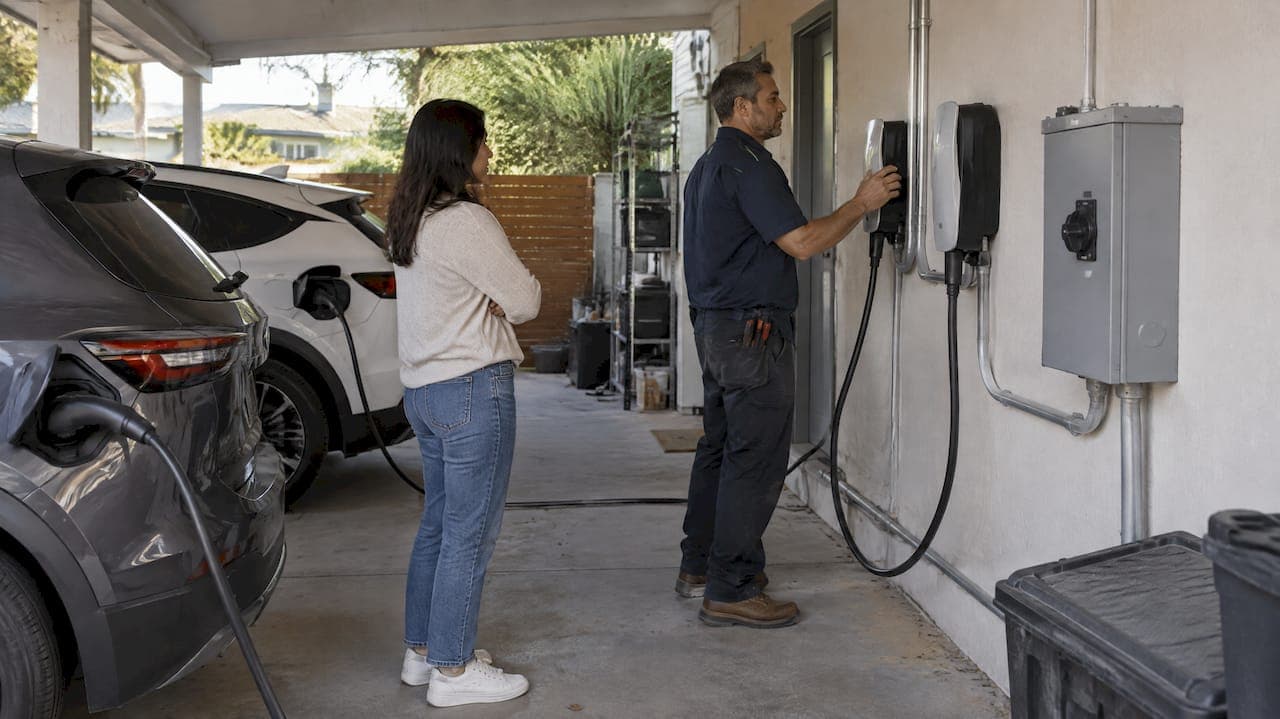

EV load management lets multiple chargers share a site’s existing electrical capacity so you can add charging ports without an immediate service upgrade. It applies whether you’re running two EVs at home, managing a multifamily property, or operating a commercial or fleet charging site. The payoff is straightforward: you control demand instead of letting it control your panel, your utility bill, or your capital budget.
TL;DR:
- Active load management systems typically cost less overall than upgrading electrical service because they work within existing capacity, avoiding expensive trenching and permits.
- Implementing load management is especially important for multifamily, commercial, and fleet sites with more than a few chargers or demand charges, where to do otherwise risks oversize service.
- Using 12 months of interval data and setting a fixed load ceiling are key steps for obtaining permits and ensuring system reliability during peak demand scenarios.
- Load management systems should have a documented fail-safe state, with communication security measures like encryption to prevent potential cyber threats.
- Future advances include AI forecasting and vehicle-to-grid capabilities, which will enable more intelligent, bidirectional energy flow and further reduce infrastructure costs.
Table of Contents
- What load management means and how passive differs from active control
- Common architectures: charger sharing, controllers, and metering
- When you need it, how to size it, and what permits require
- What EVEMS costs versus a service upgrade, and what you trade off
- A step-by-step checklist for planning and deploying load management
- Pairing load management with solar and battery storage
- Where current systems still fall short
- Where the technology is headed: AI forecasting and vehicle-to-grid
- Real-world applications across site types
- Keeping connected charging systems secure and private
- Author perspective: plan for scale and grid interaction
- How Indigo Energy can help you design and install EV load management
- FAQ
- Sources
What load management means and how passive differs from active control
Load management, sometimes called load balancing or handled through an EV energy management system (EVEMS), is the practice of controlling when and how much power chargers draw so total demand stays under a defined ceiling. Instead of sizing your electrical service for every charger running at full power simultaneously, you size it for what the site actually needs.
There are two basic approaches:
- Passive management schedules charging around time-of-use rates or fixed off-peak windows, shifting demand without responding to real-time conditions.
- Active (dynamic) management adjusts charging output in real time based on live site load, utility signals, or available capacity.
Passive, schedule-only strategies have a known weakness. When a utility rate window ends or a scheduled period begins, every participating charger can ramp up at once, creating a secondary peak. Utility Dive’s reporting on managed charging describes this as a “snapback” peak and notes that active, networked systems avoid it by orchestrating load continuously rather than flipping it on and off at fixed times. For most multi-charger sites, that difference alone justifies the added cost of active control.
Common architectures: charger sharing, controllers, and metering
Three architectures show up repeatedly in the field, and each has a different footprint and failure mode.
- Charger-native sharing: A small group of chargers communicate directly with each other and divide available amperage, with no separate controller required.
- Central site controller (EVEMS): A dedicated controller monitors total site demand and throttles chargers individually, often integrating with solar, storage, or building management systems.
- Metering-based control: Current transformer (CT) clamps and interval meters feed real-time data to the controller, which is usually required to reference the main service feed rather than just the EV sub-panel.
Phase handling matters too. Split-phase residential services and three-phase commercial services both need per-port throttling logic so one leg or phase doesn’t overload while another sits idle. Fail-safe behavior, meaning what the system defaults to if communication drops, is a detail worth confirming before you commit to a product, since a poorly designed fail-safe can either stall every charger or let them run uncontrolled.
Pro Tip: Ask any EVEMS vendor to show you their fail-safe default state in writing before you sign, not just describe it verbally.
When you need it, how to size it, and what permits require
Not every site needs active load management, but the threshold is lower than most property owners expect.
- Residential: Homes adding a second or third EV, or any home where EV charging would push total demand close to the panel’s rating, typically benefit from load management before considering a panel upgrade.
- Multifamily and commercial sites: Properties installing more than a handful of ports or any site facing demand charges should model load management as the default rather than the exception.
- Fleet and public charging: Sites with simultaneous high-power charging events almost always need active control to avoid oversized service connections.
Code and permitting hinge on a few specific references. NEC 220.87 allows service sizing based on 12 months of actual interval data plus a 25% growth buffer, which is the backbone of most EVEMS permit submittals. NEC 625 covers EV charging equipment requirements directly, and UL 3141 and UL 916 listings are what most authorities having jurisdiction (AHJs) expect to see for the load management device itself. A one-line electrical diagram and a documented, locked setpoint are standard permit packet items. Pulling 12 months of 15-minute interval data from your utility or meter is the single most useful step before design, since it establishes the real peak you’re designing around rather than a worst-case estimate.
What EVEMS costs versus a service upgrade, and what you trade off
A service or panel upgrade typically means new utility coordination, trenching, switchgear, and inspection delays measured in months. A load management system is usually a fraction of that cost and a fraction of the timeline, since it works within your existing service rather than expanding it.
- Deferred capital spending: Avoiding a utility service upgrade keeps cash available for the chargers themselves or for other site improvements.
- Lower demand-charge exposure: Commercial hosts on demand-charge rate structures benefit directly from capping peak draw.
- More ports per available amp: Shared capacity means you can install more charging stations than a straight per-port sizing calculation would allow.
The tradeoff is that no single vehicle gets the full rated output of its charger at all times, since the system is actively dividing a finite capacity across active sessions. Drivers accustomed to uncontrolled fast charging may notice longer full-charge times during peak-use hours, which is why signage and basic driver communication matter as much as the hardware.
Industry research suggests managed charging could unlock substantial avoided costs for utilities and drivers, with actively managed vehicles saving significant amounts per vehicle in some modeled scenarios. Utility Dive’s summary of ev.energy research frames this as a system-wide opportunity, not a guarantee for every individual site, but it signals where rate design and incentive programs are heading.
A step-by-step checklist for planning and deploying load management
- Pull interval data. Gather 12 months of 15-minute interval data from your utility or existing meter and compute your actual historical peak. This becomes your NEC 220.87 baseline for any permit submittal.
- Choose your architecture and set a ceiling. Decide between charger-native sharing and a central EVEMS controller based on port count and future growth, then set a locked EV load ceiling that the system will never exceed. Assemble your permit packet: one-line diagram, UL listing documentation, and the locked setpoint value.
- Install metering, commission, and verify. Place CT clamps or interval meters on the main feed, run an all-ports-active test to confirm the system holds its ceiling under worst-case load, and lock the setpoint in the controller’s configuration.
- Schedule annual re-verification. Usage patterns change as more EVs join a site, so recheck interval data and system performance at least once a year.
Pro Tip: Run your commissioning test during a high-demand period, such as a hot afternoon with air conditioning running, not a quiet evening when the panel has extra slack.
Pairing load management with solar and battery storage
Load management gets considerably more useful when it’s designed alongside on-site solar and battery storage rather than bolted on afterward. Solar export and battery dispatch can absorb a meaningful share of EV demand directly, which lowers the grid capacity ceiling your EVEMS actually needs to enforce.
- Size storage and EV ceiling together: A battery sized only for backup power misses the chance to also buffer EV charging peaks.
- Model production against charging schedules: Daytime solar production paired with workplace or midday charging reduces grid draw more than overnight charging ever could.
- Treat it as one design problem: Sequencing EV ceiling, battery dispatch, and solar export together, rather than designing each in isolation, typically produces a smaller, cheaper overall system.
We walk commercial and residential clients through this sequencing as part of our EV Charging + Solar Integration design process, and our NEM 3.0 guide covers how export rate changes affect the math for California businesses specifically.
Where current systems still fall short
Load management technology has matured quickly, but it isn’t without real limitations worth planning around.
Interoperability remains the biggest friction point. Chargers, site controllers, and utility demand response programs often use different communication protocols, and a system that works well in isolation can struggle to talk to a utility’s managed charging program or to a building management system from a different manufacturer. That gap is a known adoption barrier even as utility programs scale, according to Utility Dive’s reporting.
Driver experience is another constraint. Active throttling means a vehicle plugged in during a peak period may charge more slowly than one plugged in overnight, and fleet operators or multifamily property managers need a communication plan so drivers understand why charging speed varies.
Commissioning and verification are frequently skipped or done poorly. A system that was never tested under an all-ports-active scenario can fail exactly when it’s needed most, during a true peak event, and many sites lack the annual re-check that usage growth requires.
Retrofit complexity adds cost and delay on older electrical services, particularly where panel labeling is inaccurate or where a main CT placement requires a utility outage to install safely. And while static or passive scheduling is simpler to deploy, it carries the snapback risk described earlier, meaning the easier option is often the less reliable one.
Where the technology is headed: AI forecasting and vehicle-to-grid
The next generation of load management is moving from reactive throttling toward predictive control. Machine learning models that forecast charging demand and combine it with optimization algorithms are already showing results in fleet applications. A depot-scale study using this approach found it could avoid more than 90% of on-peak charging and cut peak load by over 60% in modeled scenarios, according to a Department of Energy Livewire publication on medium and heavy-duty fleet charging. That same forecasting logic is beginning to appear in commercial and multifamily EVEMS products, not just fleet depots.

Vehicle-to-grid (V2G) and vehicle-to-home (V1G-adjacent) capabilities represent the other major shift. Rather than only limiting how much power a vehicle draws, future systems will increasingly let a parked EV’s battery discharge back into a building or the grid during peak periods, turning load management into two-way energy management. This is still an emerging capability for most consumer vehicles and chargers, and widespread V2G deployment depends on vehicle manufacturer support as much as charger hardware.
Utility programs themselves are scaling in this direction too. The Department of Energy’s federal fleet guidance already frames managed charging as a tool to reduce costs and avoid infrastructure upgrades, and that same framework is extending from fleets into general utility demand response programs as EV adoption grows.
Real-world applications across site types
Federal fleet operations offer one of the clearest documented examples of managed charging in practice. The Department of Energy’s guidance for federal fleets describes how controlling charging events, rather than letting every vehicle plug in and draw full power simultaneously, reduces costs and avoids infrastructure upgrades that would otherwise be necessary to support a growing fleet.
Medium and heavy-duty depot charging shows a similar pattern at a larger scale. The optimization framework detailed in the DOE Livewire study combined energy demand forecasting with linear-program optimization across a full year of simulated operation, and the resulting peak load and cost reductions illustrate what’s achievable when charging schedules are actively optimized rather than left to driver habit.
Residential deployments tend to be smaller in scale but follow the same logic. Open-source home energy integrations, such as the Home Assistant EVSE load balancer project, use risk-factor algorithms that mimic how a circuit breaker actually responds to heat over time, so a brief appliance spike doesn’t trigger unnecessary charger throttling. That kind of nuance, tolerating short-term spikes while still protecting the panel, is what separates a well-tuned residential system from one that simply cuts power at the first sign of load.
Commercial and multifamily sites sit between these two extremes: fewer ports than a depot, but higher stakes than a single home, which is why the sizing and permitting steps covered earlier matter as much as the technology itself.

Keeping connected charging systems secure and private
Any EVEMS that communicates with chargers, utilities, or cloud dashboards is, functionally, a piece of connected infrastructure, and that brings data privacy and cybersecurity questions that didn’t exist with simple, unmanaged chargers.
Charging data can reveal patterns about when a building is occupied, how many vehicles are on site, and in commercial settings, operational details a business may not want exposed. Site hosts should ask vendors directly how charging and usage data is stored, whether it’s shared with third parties, and how long records are retained.
On the security side, a networked controller that can remotely throttle or enable charging is also a potential point of failure if compromised. Reasonable baseline expectations include encrypted communication between chargers and controllers, firmware that receives regular security updates, and a documented fail-safe state (discussed earlier in this guide) so a communication breach or outage defaults to a safe condition rather than uncontrolled charging. Open documentation projects like evcc’s load management framework show how circuit-level configuration and meter visibility can be handled transparently, which is a useful benchmark when evaluating a commercial vendor’s own documentation.
For property managers and fleet operators in particular, it’s worth treating EVEMS procurement with the same security diligence applied to any other networked building system, rather than assuming charging equipment is low-risk simply because it controls power rather than data.
Author perspective: plan for scale and grid interaction
The biggest mistake we see is sizing a load management system for today’s EV count instead of tomorrow’s. Charging demand only grows, and a system designed with no headroom for V1G or future V2G participation gets replaced sooner than it should. Prioritize a measurable, documented ceiling and commit to the annual re-check, since usage patterns shift faster than most property owners expect. And talk to your utility early. Many have managed charging or demand response incentive programs that can offset part of your system cost, but only if you ask before you finalize your design.
— Curtis Williamson
How Indigo Energy can help you design and install EV load management
We provide services including site assessment, NEC-based load calculations, permitting support, and integrated EV charging, solar, and battery storage installations.

- Our initial assessment includes a review of interval data and an ROI analysis before you commit to any equipment.
- We size EV charging capacity alongside solar production and battery dispatch to help avoid unnecessary service upgrades.
- Every project includes permitting support and warranty coverage.
If you’re planning EV charging for a home, property, or business, start with our EV charging and solar integration services to get a design built around your actual electrical capacity.
FAQ
How much does an EV load management system cost?
Published pricing varies widely by site size and architecture, so we don’t have a single reliable figure to cite here. In general, a load management system costs meaningfully less than a full service or panel upgrade, since it works within existing capacity rather than expanding it.
What is load management in EV charging?
Load management is the practice of controlling how much power EV chargers draw, individually or as a group, so total demand stays under a set ceiling. It lets multiple chargers share existing electrical capacity instead of requiring a larger service connection.
Which EV charger has the best load management system?
The right system depends on your site’s port count, electrical service, and whether you need charger-native sharing or a central EVEMS controller, so there’s no single best charger for every situation. Ask any vendor for documentation on their fail-safe behavior and UL 3141 or UL 916 listing status before comparing products.
Do EV chargers need load management?
Not every charging site needs it, but any home adding a second or third EV, or any multifamily or commercial site installing more than a handful of ports, typically benefits from load management before a service upgrade becomes necessary. Sites facing demand charges should treat it as a default design step rather than an optional add-on.
Sources
- As EV load grows, utilities use managed charging to harness flexibility, lower costs | Utility Dive
- Managed EV Charging for Federal Fleets | Department of Energy
- Load Management for EV Charging Sites: The Engineer’s Field Guide
- Energy demand and cost management framework for MHD BET depot charging (Livewire / DOE publication)